Posts

Thoughts on the New TV Season, 2016 Edition

This week has seen the first inklings of the new TV season, as the US networks start trotting out shows in the hopes of success, legitimacy, or even the tiniest bit of attention.  And yet here I am, still talking about some of the shows of summer.  This is partly because, as we've all more or less accepted, network shows just aren't where it's at anymore, and there isn't that much to say about yet another raft of samey procedurals and underbaked high concepts.  So this post covers a British miniseries and a Netflix series, as well as a few network pilots.  Still, I do enjoy this time of year, and I keep hoping that one of these shows will surprise me, so stay tuned for further reports.  (Not discussed in this post, because there wasn't much to say about them: Designated Survivor , which has an ironclad elevator pitch that I'm not sure it knows what to do with, and Notorious , which seems desperate to be a Shondaland show but actually feels more like a parody o...

The Strange Horizons Fund Drive

Strange Horizons , the erstwhile speculative fiction magazine, is currently running its annual fund drive .  I've had a close relationship with Strange Horizons that has spanned most of my writing career.  They were the first magazine to publish my reviews, thus bringing my work to a wider audience.  I served as the magazine's reviews editor between 2011 and 2014 (which means that my name appeared on the Hugo ballot when it was nominated in the Best Semiprozine category).  And I continue to write for them today, most recently in my two - part review of this year's Clarke shortlist. But beyond my relationship with it as a writer, what makes Strange Horizons special and important to me is the material it's put before me as a reader.  A lot of the testimonials you're going to see around the internet in the next few weeks are going to talk about Strange Horizons 's fiction department, which has and continues to give platforms to new writers, many of whom have g...

The Underground Railroad by Colson Whitehead

The long opening segment of Colson Whitehead's The Underground Railroad is carefully, almost studiously naturalistic.  In plain, but also irresistible and affecting language, he presents the life story of his heroine, Cora, starting first with the history of her grandmother, kidnapped from Africa and finally ending up, after much circumlocution (which is to say, being sold and re-sold), on a Georgia plantation, and moving on to detail the life of Cora's mother, who escaped when Cora was a child, and finally to Cora herself.  Whitehead's eye for the details of life on the plantation--and in particular, life in the insular, predatory community that arises among the slaves--is unflinching.  Many reviewers before me have noted the brutal quietness with which he reveals that "Not long after it became known that Cora's womanhood had come into flower, Edward, Pot, and two hands from the southern half dragged her behind the smokehouse.  If anyone heard or saw, they did no...

Recent Reading Roundup 41

Image
It's been a little quiet on this blog over the summer, mainly because I've been busy with various projects for other venues (for example the Clarke shortlist review ).  But also, because I've been busy reading.  A lot.  2016 is shaping up to be one of--if not the--most prolific reading years of my life.  Quality-wise, it's also been very rewarding, and though my other writing prevented me from giving some of these books the more in-depth look they deserved, this is still an impressive bunch of books, and worth a closer look. Uprooted by Naomi Novik - Novik's Nebula-winning, Hugo-nominated novel--her first standalone after a decade with the His Majesty's Dragon series--has echoes of Howl's Moving Castle and Seraphina , and stands up reasonably well alongside those antecedents.  In a thinly-glossed, cod-medieval Eastern Europe, a wizard known as the Dragon exacts a mysterious but unrelenting tribute from the residents of the villages that border the mal...

Review: The 2016 Arthur C. Clarke Award Shortlist, part 2

The second part of my review of this year's Clarke shortlist is now online at Strange Horizons , covering Arcadia by Iain Pears, Europe at Midnight by Dave Hutchinson, and The Book of Phoenix by Nnedi Okorafor.  You can find it here , and in case you haven't already read part 1, that's here .  The actual winner will be announced in London in a few hours, but as I write in the conclusion to the review, I tend to see that announcement as less of a triumph for any particular book, and more a data point that will help to clarify--at least a little--what the judges were aiming for with this year's bland and conventional shortlist.  The book that wins will tell us a great deal about how this year's judges saw the Clarke, and their task as its jury.  But I'm hopeful that next year the jury will make more interesting, more challenging choices. Martin Petto has updated his collection of links to discussion of the shortlist, including this essay by Megan of the (ne...

Review: The 2016 Arthur C. Clarke Award Shortlist, part 1

The first part of my mega-review of this year's Clarke Award-nominated novels appears today at Strange Horizons .  This is the fourth time that I've reviewed the entire shortlist, a tradition begun by Adam Roberts at Infinity Plus and carried on by Strange Horizons with rotating reviewers.  I'm sad to say that this was by far the least fun I've had reviewing the Clarke shortlist, not so much because the nominated books are bad--though a few definitely are--but because there ended up being so much less to say about them than I'm used to. After finishing my read-through of the nominated novels, I started reading a few of the books that were  submitted for consideration , and the difference is striking.  It's not so much that the books left off the Clarke shortlist are masterpieces--on the contrary, I would have had serious reservations about most of them if I'd had to review them for this project.  But that's precisely the point.  I would have had so ...

The 2016 Hugo Awards: Thoughts on the Winners

A month ago, when I posted here to remind people that the Hugo voting deadline was coming up, it was with a bit of trepidation.  Last year, when puppies of various stripes decided to get their jollies by trying to tear down this award, we saw a huge influx of new voters who showed up to make it clear that this was unacceptable behavior.  That the Hugo belongs to the people who care about it, not people who try to use it to score outdated, bigoted political points, or further their fevered personal agenda.  This year, it was clear that a lot of those same voters weren't coming back.  They had made their point, and were, quite reasonably, moving on to the things that interested them.  It's a funny fact about people who spend their lives concentrating on the things they care about, not the things they'd like to destroy, but it's usually a lot harder to corral them into action against the latter.  Which is great, but also potentially worrying, because if the p...

The 2016 Hugo Awards: Two Weeks Out

In two weeks, voting for the 2016 Hugo Awards will close.  You could be forgiven for being taken aback by just how quickly that deadline has rolled up on us, seeing as, especially compared to last year's all-Hugos-all-the-time news extravaganza, the conversation surrounding this year's awards has been so muted that at points it's seemed that the only person even participating in it was Chuck Tingle .  And even he seems to have found other interests recently.  And on one level, it's easy to see why the Hugos have fallen by the wayside this year, given that we're in the middle of a news cycle that has included, in the last month alone, terror attacks in Orlando, Baghdad, and Nice; two black men shot by American police officers while committing no crime and a sniper attack on a peaceful protest that left five police officers dead (edit: in the six hours since I wrote the first draft of this post, another such shooting seems to have occurred in Baton Rouge; WTF, Americ...

Review: A Midsummer Night's Dream, adapted by Russell T. Davies

Today at Strange Horizons , I write about Russell T. Davies's adaptation of Shakespeare's A Midsummer Night's Dream for the BBC.  It was a bit of a surprise to me that this film even existed--whatever promotion there was for it seems to have been swallowed up by the media blitz for the second season of The Hollow Crown .  And as I write in the review, this turns out to have been massively unfair, because whereas this year's Hollow Crown sequence was an uninspired slog enlivened, here and there, by a few fine performances, Davies's Dream is witty, fun, and most of all very smart in its approach to the play and its problems.  To be clear, this is still a Russell T. Davies production, with all the good and bad things that implies (the Murray Gold soundtrack is quite a hurdle, for example).  But ultimately, he and the play turn out to have been a perfect match, and the result is one of the most rewarding Shakespeare adaptations I've seen in some time. My posit...

Recent Reading Roundup 40

Image
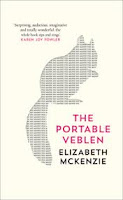
2016's reading continues to be rewarding, and though perforce less swift now that I'm no longer on holiday, still moving along at a steady clip.  This bunch of books includes several that I can already tell will be on my list of favorite reads at the end of the year. The Portable Veblen by Elizabeth McKenzie - This spring's it-litfic comes with blurbs by Ursula K. Le Guin and Karen Joy Fowler, and has a quasi-literary, quasi-romantic, quasi-slipstreamy premise that seems instantly appealing.  The novel spans the short but eventful engagement of Veblen, an underachieving temp worker and sometimes translator who lives in a storybook house in the woods and talks to squirrels (who sometimes talk back), and Paul, a neurologist whose new gadget to prevent traumatic brain injury in the field has been picked up for testing by the US military.  Right off the bat, the book feels like an invigorating blend of the personal, the political, and the topical.  Veblen, whose ret...